Saturday, October 3, 2015

Xi’ an

Xi’an

We flew to Xi’an in the middle west (the hub on the map in the picture) for a two day visit. Brian told us it is a small city of "only" seven or eight million and only three ring roads. Our first impression was that it was prettier and had more trees than Beijing, but it has just as much crowding, litter and poor areas.  Our guide here Tracy (Cui Jing) was more open to talking about conditions in China than Brian was.  He said there are no homeless even though we saw some.  Tracy said yes, many homeless and beggars.  Brian did not know unemployment rates; she said sometimes high.

Xi’an was the capital of the first empire, the Qin, 220 BC.  The Tang Dynasty, 618-907, was one of the most dominant and influential in earlier history.  Royal and ceremonial buildings were not as ornate and colorful as in the Ming later in Beijing.  Grey, green and red were used more than the blue and yellow and gold of the Ming.

Xi’an has the only intact city wall left in China; 90% is original.  It is wide and level on top, making a popular place to walk or ride bikes over its nine mile rectangular perimeter.  When it was built 600 years ago, 98 ramparts were spaced an arrow shot distance apart.

  Four main gates are in the center of the four walls, each with three gates to get through for defense. 


  A moat surrounded it, much of which is still there.  A beautiful park now fills the space between the wall and the most.  

Buildings in the old city are limited in height.  The high rise buildings are outside the walls.


One night we had dumplings—about 15 kinds with vegetables or meats, some twisted into clever shapes.  Since we were mostly a Eugene, Oregon group, the little yellow ducks were a hit. 


Ban Po is an archeological site of a large village from 6,000 years ago.  It was a matriarchical society near a river, quite advanced in their use of tools and decorated pottery.


The Small Wild Goose Pagoda was originally a center for Buddhist monks of the Tang Dyn sect to study and meditate 600-700 years ago, but it is now a public park. Buddhism was the official religion and the Emperors’ support gave monks high status. Some went to India, the source of Buddhism to study for a number of years and then returned here with many books.  So this stone temple complex included an important Buddhist library.  


We had a short but informative calligraphy lesson that gave a basic understanding of how the Chinese characters used for writing work. We painted one ourselves.  Great fun.  Chinese artwork must have stamps on them.  The top one is for happiness and long life, the second for love, and the bottom one for success.

Our theater entertainment in Xi'an was Tang style dance show.  Magnificent.


We had the misfortune of traveling in China during the biggest national holiday, October 1–7. Mao Tse Tung “liberated” China on October 1st, 1949. Many Chinese take a whole week holiday for National Day, so tourist spots are crowded.  October 2nd  was Terra Cotta Warrior day for us. Normally it has 30,000 to 40,000 people visiting daily. During National Holiday week, 70,000 to 80,000 is typical. The main site there, Pit # 1, was packed.  We had to fight full-length body contact layers of people 15 deep in front of the railings around the pits containing the warriors.  Many in our group did not get to the front.  As we were buffeted around, I thought this is how people can get trampled in a crowd.


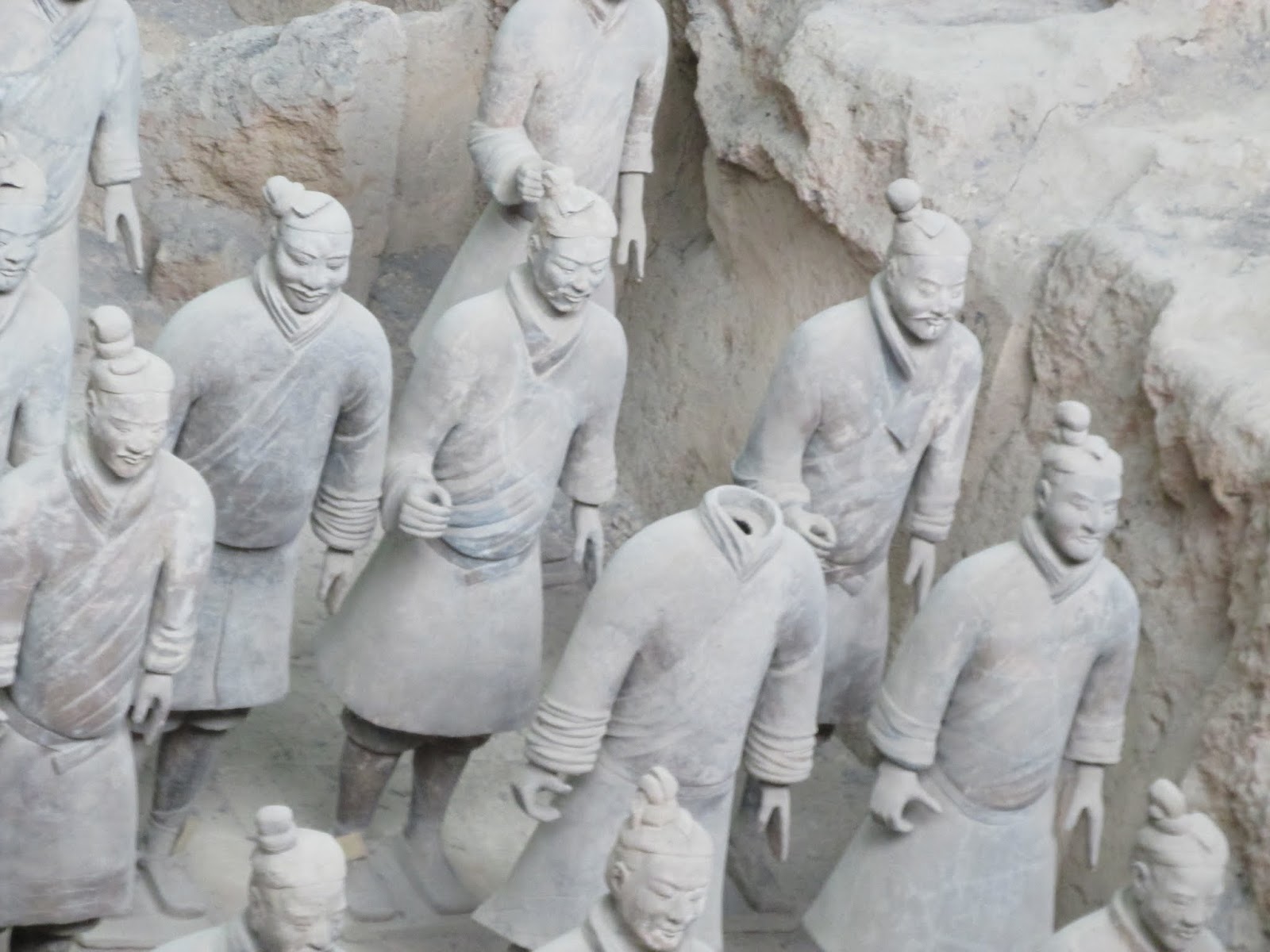
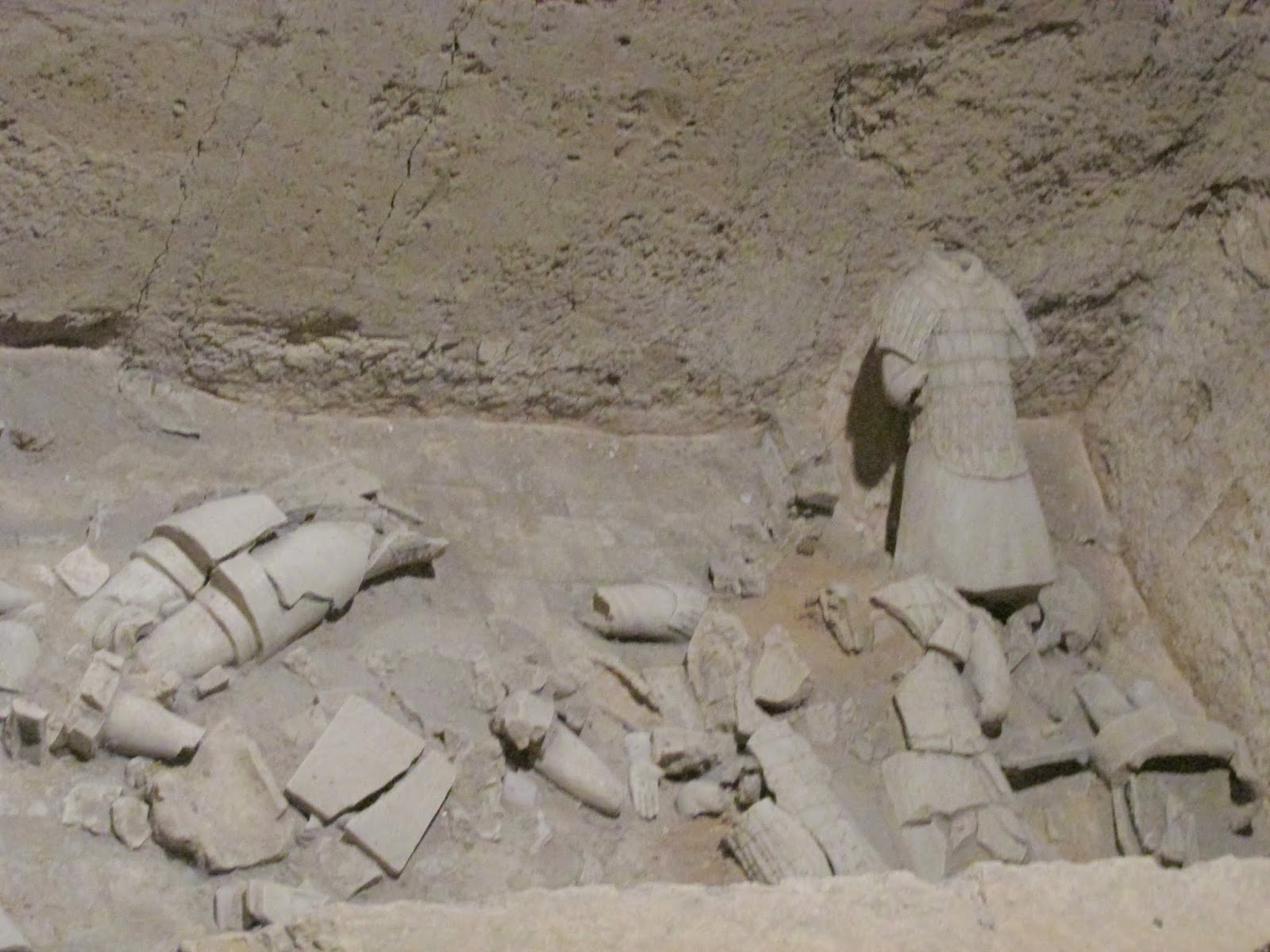
Quick history lesson.  In the centuries BC, China was a composed of a number of independent kingdoms. The Qin (pronounced Chin) king conquered all seven large kingdoms and united them for the first time in 221 BC.   He declared himself Qin Shi Huang (First Emperor of the Qin).  This may be where the name China came from.  He started building the Great Wall and the first roads.  He standardized currency, measures, and most importantly language and writing.  He also continued his mausoleum, the largest of any king previous.  His brutal wars and treatment of common people had reduced the population, so instead of killing all his warriors to guard him in the afterlife, he had artisans build an army of terra cotta using the local clay which was the best in China.  So far 8,000 life-size soldiers, infantry, archers and officers have been uncovered in three large underground chambers.  Most were broken, but archeologists have restored great numbers and arranged them as they originally were buried.  Traces of paint indicate that the warriors probably were fully colored.


We also visited the nearby factory where official reproductions are created. The legs are solid but the torso is hollow.  It would be too large to dry and fire without losing shape if solid.  The heads are made separately. The originals were made from coiled pottery and then shaped.  Every head is different, presumably made to mirror a live warrior.  The originals were signed in inconspicuous places showing that 87 different craftsmen created them, each with  staff of ten or so.  The warriors have a top knot, the officers a square hat, the archers a top knot off to the side, and the generals two knots.


After our tours much of the day, we went to a tea house to have a tea demonstration and tasting of a number of different Chinese teas.  Just as we were seated, the police ordered the building evacuated due to a gas leak.  Some people had gone upstairs to the restroom, so we had a bit of panic before everyone was accounted for and we left the area.  No tea.

Dinner one night was Chinese Hot Pot. We mixed various ingredients to create our own sauce—sesame oil and paste, leek paste, soy sauce, garlic, bean curd paste, Chinese barbecue sauce, chopped scallions and more.  Each person had a pot of boiling water over a small burner to cook her own food from plates on the lazy susan—bok choy and other greens, raw egg, tofu, crab, noodles and thin sliced beef and lamb. The sauce made it delicious; the activity and mishaps made it fun. 


Huge pomegranates and persimmons grow well here and were being sold along the roads everywhere.  We wished we could stop the bus and buy some.

Thursday, October 1, 2015

Shanghai


We flew to the largest city in China, Shanghai.  I had no expectations.  My dream for China was the Great Wall, Forbidden City and Terra Cotta Warriors.  I knew nothing about Shanghai.  Soon I loved it.  Shanghai means “up from the sea” as it is located on the delta of the great Yangtze River.  I thought I could not like a Chinese city more than Beijing.  I thought Brian was the best possible guide.  Shanghai and Jack proved me wrong.

Shanghai was a small fishing village 500 years ago and had 15,000 people in the 20th century.  Now Shanghai has 25 million people, largest city in the world.  Again the high rises are endless.  But Shanghai has a beauty and vitality that charm you quickly. The Yangtze and Huangpu Rivers have made Shanghai the most important port in China.  The Huangpu divides the city into Puxi and Pudong, old and new.  Along the riverfront park, the Bund, people stroll, dine and take in the view of barges and pleasure boats on the busy Huangpu River and extraordinary architecture lining the banks.  We returned after dinner and thrilled to a boat cruise on the river.  The old buildings on the Puxi side are beautifully lit (reminiscent of Budapest).  The new skyscrapers of the Pudong side have amazing light shows that keep changing.


Jack said that Shanghai has knock off Rolexes, electronics and buildings.  The Chrysler Building.  The Empire State Building.  London’s Big Ben.   Some of these are in the European sections of the city dating from the Opium Wars and the British and French attempts to colonize China to control its trade in the 1800's.  Interesting side-note on that period:  the Chinese thought the British were barbarians as they stormed in and tried to take over.


 Shanghai also has the third tallest TV tower in the world.

A new skyscraper, the Shanghai Tower, that would be the world’s tallest if they put a 100 foot tower on top like Dubai.  The bottle opener building is the Shanghai World Financial Center.


Bicycles were the way to get around 20 years ago, but the explosion in size has required more options.  There are 20 subway lines.  Big highways crisscross the city using many tunnels under the rivers and eight beautiful huge bridges.  First floor apartment go cheap because no one wants to live with the noise of the frequent subway trains.  But a 1000 square foot apartment in a new high rise can cost $1,000,000.

The fastest train in the world for the last 10 years connects the main airport to the downtown area.  The cost of one and one half billion dollars has prevented it from being expanded to any great distances.  The Maglev (magnetic levitation) travels 430 Kilometers per hour or 268 mph.  Other long distance high speed trains have speeds of 180 mph.


We visited a silk factory where we saw the life stages of the silkworm and how they double in size every five days until they make a cocoon after only 25 days.  We saw how the mile of silk filament is unwound from the single cocoons and twisted into thread.


Double cocoons with two pupae have two filaments all twisted together.  Those are softened in hot water also, and the mat of filaments is pulled out and stretched over a frame.  One double cocoon mat can be stretched to cover a queen size bed.


Layers upon layers are joined to make quilt bats that are allergy free, light, strong and long-lasting.  Silk thread is used for suturing by doctors.  The pupae are used to make medicine.   We also saw a rug factory.  Simply gorgeous.


Cameras are everywhere on the streets, so few cars are stolen.  Police do not carry guns, but military do. They don't have a murder rate.  Guns are illegal.  As the Chinese told us, if you get in a fight with someone, you may get punched.  But no one dies because no one has guns.  I remember that my students from a lot of different countries were somewhat afraid to come to the US because we are such a violent, gun-crazy country. 

Lunch one day was Mongolian Barbeque where we filled a bowl with whatever meat, vegetables and seasonings/sauces we wanted.  Then the grill chefs tossed and chopped it on a huge flat griddle. Absolutely delicious.


We shopped at the old town bazaar.  The buildings were fanciful and enchanting.


Our evening entertainment was the ERA Intersection of Time.  It is a Chinese version of a Cirque du Soleil type show.  Spectacular.  


I think our whole group of 31 was surprised by some things, impressed by Chinese history, wowed by the sights, and delighted with our Chinese guides.  Isabella liked Shanghai and its amazing light show on the buildings at night.  Iona said, "the day we went to see the terra cotta soldiers.  I was really impressed with the size of the crowd there, even though we didn’t have a great view or experience there, the whole day was an unforgettable experience.  I was impressed by the number of Chinese who were visiting their historic spots."  The sheer size of the cities and the numbers of people was a bit overwhelming.  Who would think that 80,000 people, mostly Chinese, would be visiting a museum in one day?  Carol, having visited other communist countries, was a bit surprised that "China is really capitalist, and while the government calls itself communist, it really does not take care of its people.  Communism is dead."  She also said the best was us two sisters going together.  I agree with that.  I will broaden that to include everyone.  Our group was interesting, energetic, and lots of fun.  Our guides loved our teasing and seemed to enjoy us too.


I came home with a great new respect for China and its people.  I have been guilty of a Euro-centric view of history, so learning how advanced the ancient Chinese civilizations were impressed me greatly.  The people we met were friendly, funny, and eager to share their amazing country with us.  I had said I wanted take advantage of this opportunity because I will never get to Asia again.  I am ready to return for a longer trip.


Wednesday, July 29, 2015

Rhine and Danube River Cruise, Part 2


The Danube River

We have been enjoying the half-timbered houses and flower boxes--fairy tale beautiful houses.  Now on the Danube we are seeing a different kind of medieval homes. They are solid stone and blocky. Germans have an expression that someone is “stone rich.”  Only the wealthy could afford to build large houses of all stone, faced with stucco and adorned with ornate windows.


Regensburg

Regensburg is the oldest city on the Danube dating to a Roman camp in 179.


It became wealthy as a trading crossroads when in the 1100’s they built a massive stone bridge across the Danube, the only bridge between Ulm and Vienna, some 750 kilometers.
Salt coming up from Passau was stored, taxed, and sold here.  


Patrician merchants showed off their wealth by building large Italianate homes with towers. The lower level was often a shop and storage of goods.  The tower was mainly for show as upper floors were not used. Note the balcony and how each window in the tower is different from the others.


Regensburg’s Gothic cathedral has magnificent stained glass windows.


Trade routes changed in the 16th century, and Regensburg lost its status as Germany’s second largest city as trade floundered.

Passau

Passau, on the German Austrian border, is at the confluence of three rivers: the Inn, the Ilz, and the Danube, each with a distinct color.  The Inn here on the right is light with glacial deposits.  The Danube on the left is not really blue. 

Passau was an important medieval center for the salt trade coming from Alpine salt mines. Three rivers coming together leads to flooding possibilities and Passau has had more than enough of those, especially since the Inn River comes swiftly down from the Alps, glacial green and wild, sometimes with such force that it backs up the Danube flooding the city.  They are still repairing damage from the 2013 flood which is the highest water level shown here.


Passau’s jewel is St. Stephen’s Cathedral on the highest hill in the old city.  Baroque with a Gothic chancel, the interior is stunning with elaborate stucco statues and trim around countless frescos.

The star, however, is the pipe organ, the largest church organ in the world with 17,974 pipes, 233 stops, and 4 carillons.  We were fortunate to be there for a half hour classical concert.  It filled the huge sanctuary. Powerful experience.


Melk

Melk Abby has been here over a thousand years. The 60 monks who still live there follow Benedictine precepts of prayer, study, obedience, honor and listening—listen to God, to the order, to self, and to the heart. They all have jobs, many teaching in the Abbey school of 800 students or serving as priests to neighboring parishes. 


The library is phenomenal with 85,000 volumes and 80,000 medieval manuscripts In 12 rooms.


Wachau Valley

The Wachau Valley of the Danube is a UNESCO World Heritage site where the architecture, settlements and use of the land illustrate a harmonious medieval landscape.  It is perhaps the loveliest stretch of the Danube with ancient castles, vineyards, monasteries, and charming villages hugging the river.  Some cliffs are up 1000 feet high above the river.

Schoenbuehl Castle

Hinterhaus Castle at Spitz

Durnstein.  Here the vineyards are planted horizontally.

Kuenringer Castle where Richard the Lion-hearted was kept for a year after being captured after a Crusade.


Many bridges along the Main and Danube are lower than comfortable.  For a few days the top deck was closed and all railings and table flattened.  Here it was open again, but for this bridge we were warned to sit down.  The Captain's wheelhouse actually lowers hydraulically down into the third floor.


Tonight was Austrian night in the dining room with many of the staff dressed in traditional dirndls and lederhosen.  The food was a buffet of Austrian and German food—fabulous.  A pair of musicians played accordion and guitar to add to the festivities. Don and I danced a couple polkas, of course.


We also got to tour the kitchen.

Vienna

What a beautiful old city Vienna is.  The Hapsburg palace is enormous and beautiful. We toured the treasury and saw the Crown Jewels, coronation robes and endless valuable, jewel-encrusted treasures.


Expansive palace gardens.  This is the statue of Mozart.


St. Stephen’s Cathedral is another amazing church.  The multi-colored tiled roof is unique. 


We attended a Mozart and Strauss concert that included several opera singers and ballet dancers performing with some of the numbers.  We sat near the drummer and enjoyed watching him tossing the drumsticks and relishing his part. Many of the musicians smiled as they played.  Lovely evening. 


Bratislava

Bratislava was a contrast to Vienna—small for a capitol city, and trying to rebuild and recover from their liberation from communism only 25 years ago. 

Our guide was so much fun and informative at the same time.  She said that churches always remained open here.  Perhaps the Soviets valued their munitions factories so much that they looked aside from some practices. 


St. Martin’s Cathedral had beautiful old carvings on the choir seating area. 


Bratislava has a number of whimsical statues in the old town area.
Napoleon’s soldier looks over Don's shoulder.

The Happy Man, the real Ignac Lamar, wandered about town greeting people charmingly well dressed, though he was actually poor.  Jerry tries the hat for size.

Cumin, the sewer worker, would rather watch people than work. 

The cruise ends at Budapest tomorrow, so we began our good byes to favorite Viking people.  Raul was the wine waiter who kept refilling my wine glass at dinner and made sure I had a full glass to take with me for the later evening. He also brought Don’s beer the moment we entered the dining room. He is from the Phillipines.


Irina from Bulgaria was our favorite waitress.  She sometimes urged us to live on the wild side and have more to eat.

Joey from “Nederlands” is the program director who seemed to do everything.  He was a comedian during his briefings. He made the trip so much fun.

This was also the last of our cultural nights.  A three piece combo and pair of Hungarian dancers put on a delightful show.


Budapest 

We sailed into Budapest after dark to be treated to the amazing lights of the “Queen of the Danube.”

Parliament 

Castle Hill

The Chain Bridge was the first bridge between Buda on the west hilly side of the river and Pest (pronounced Pesht) on the Hungarian plain. The two cities soon became one. 

The Parliament building on the shore is a neo-Gothic wonder. 

Castle hill with the beautiful St. Matthias Cathdral

Fisherman’s Bastion was on the part of the wall the fishermen were obliged to defend, and in return they were allowed to sell their catch there.  The fanciful white turrets were built as part of the millennial celebration of 1000 years of Hungary’s existence in 1896.  

The royal palace on the hill in Buda.

We took a drive north of Budapest to Szentendre (St. Andrews), a charming arts village where we toured the Margit Kovacs art museum and indulged in a wonderful dessert at a coffee shop. Alice and I both splurged on jewelry:  an art glass pendent for her and a grey amber ring for me.


Dohaney Synagogue in Pest is the second largest in the world, but largest in seating capacity, nearly 3000.  It was designed by a Christian architect in 1859,  so the building is set up like a Christian cathedral with the shape, the pulpit and even an organ which Jewish synagogues never have.  Orthodox Jews believe organ music is bad because it distracts from the service.  Men sit in pews on the main floor and women in the balconies. Services are traditional to please the most of the Jews.


The museum had beautiful pieces of sacred service items.  Spice boxes used for Havadallah, the short Saturday sun-down service which is intended to purify the devout and prepare them for the coming week.  They light a braided candle, breathe in the scent of cinnamon and other spices and drink a bit of wine in a very spiritual service.

We wandered  in the garden to see the beautiful metal willow tree memorial covered with metal leaves containing names and the date and place of death for Hungarian Jews caught in the ghetto in the last year of WWII.   

We also saw the cemetery from that short year when Jews were forced stay within the ghetto and could not take bodies out to cemeteries outside the city.  The mass graves hold 3000 Jews who died during the war there.  

Hungary had 800,000 Jews before the war; 600,000 perished.  Many of the Jews before the war were successful businessmen, doctors, attorneys, and other professionals.  That meant nothing to the Nazi’s who took over their property and shipped men out to Auschwitz. Budapest has perhaps 100,000 Jews now.

During the war when the Soviets occupied Budapest, the Gestapo set up an office in the balcony of the Synagogue. That kept the Germans from bombing the building.  The allies would not bomb it because the Jews were there so the Synagogue escaped with minimal damage.  During the Soviet regime people were allowed to practice their religions.


The churches of Budapest have the same colored ceramic tile roofs as St. Stephen’s in Vienna.  St Matthias up on Castle hill is different inside from most of the opulent gold, stucco and carvings that we have seen in most of the cathedrals and even smaller churches.  This one is colorfully and heavily painted.  The effect is lovely, even without the millions spent in gold leaf. 


Our hotel is the Hilton on Castle Hill, next to St. Matthias.  This is a historic district, and the  Hilton was not allowed to remove the ruins on the site.   So they incorporated the ruined walls into the modern building,  The effect is charming.

The view from our room

The 500 foot high Castle hill is named for the large royal castle overlooking the Danube which has been renovated and contains the national library and national gallery.  

Various stairways lead up the hill for people to access the top.  In 1870 the funicular, a steep tram, was built to carry people up and down with no effort.  It is still popular.


Inside the hill is a warren of caves that were used for centuries for storage of food, wine and other things.  During WW II the caves were formed into an underground hospital that was safe from bombing. Built to serve 60 patients with triage areas, one operating room and several wards, the hospital saw hundreds of patients at a time.  Many died because of crowding and lack of sophisticated facilities, but many more lives were saved.  During the Cold War and Hungary’s revolution, the hospital was fitted out as a bunker for government officials and as a bomb shelter.  Fascinating place.


Don and I spent an afternoon at the Szecheni spa in Pest, a series of outdoor and indoor pools of hot mineral spring water ranging from 40 degrees Celsius (104 Fahrenheit) to very cold. It was a lovely relaxing afternoon.


We have had Hungarian goulash several times.  The national peasant dish is a delight.  Chicken Paprikash was also wonderful.


Hungary’s millennial celebration in 1896 celebrated 1000 years as a country.  It was at times large and small, independent and subjugated, pastoral and imperial, but a always proud magnificent country reigning over the beautiful Danube River.  Despite record heat while we were there, we wished we had more time in Budapest.


The Danube is not blue, but it is a lovely river with wooded banks, swans and low traffic compared to the Rhine.  We have decided that this is a wonderful way to travel. I hate to see it end. 


Our look at Europe from the water was a fascinating experience. We gained new respect for how vital rivers are for navigation and trade, for defense and escape, for recreation and esthetics.  We saw how water is the lifeblood of the towns and also an agent of death when they flood.  We were struck again as Americans usually are, by how old everything is.  Often we heard that the "new" church or city hall was a couple hundred years old.  The history is complicated and nuanced.  The people are friendly.  And the scenery is fabulous.  We can't wait to go again.