Slidell, Louisiana, January 1-13, 2006
We drove our little fifth-wheel camper through Louisiana with a bit of apprehension. What were we getting ourselves into? Slidell is on the north-eastern shore of Lake Pontchartrain, and during Hurricane Katrina it suffered a 20 foot storm surge that crushed the lakefront and flooded half the town. Miles from Slidell, I thought people just didn’t care about litter around here; then we realized that much of it was still hurricane debris. Four months after Katrina, many houses still wear blue tarps on the roofs. Houses and other buildings gape open with walls missing. Piles of debris, furniture, mattresses, sheetrock, insulation, and tree trunks line the streets. Many businesses are still closed. Those that are open have help-wanted signs and shortened hours. RV’s and FEMA trailers are in many parking lots and front yards—people are living in them while they gut and repair their houses. PODS (Portable On Demand Storage) are everywhere, holding whatever people could salvage until they have real homes again.
Ever since Katrina and Rita and Wilma and the others, we have wanted to do something to help, so we signed on with Habitat for Humanity East St. Tammany. Habitat builds modest homes for people who would not otherwise be able to buy a home. They must put in hundreds of hours of work on their house or others and be able to make affordable, no-interest mortgage payments.
We found our campsite—a Lutheran church back lot recently cleared of woods and brush that had been made into a campground for volunteers who came here to help. The whole area was muddy, but we were pleased to learn they had put in camper hook-ups the week before. Many area churches are putting camping facilities in their parking lots or ball-fields to encourage volunteers to come.

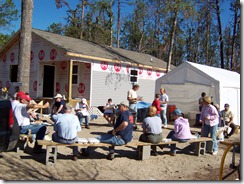
Monday morning, January 2, we reported for our first day with Habitat. Devotions are at 8:00 AM daily; then everyone gets work assignments. We were assigned to Harry from North Carolina, the vinyl siding expert of many Habitat builds. We buckled on our new tool belts and went to work. Dusty Dog, Don’s Leader Dog for the Blind, gets tied to a tree near where we are working. Since Don has limited vision, he and I work together—I measure and mark, Don cuts the siding, and we both nail it up. The first day wiped me out; I am used to wielding a pencil and a computer mouse, not a hammer.
During our two weeks here, Harry has taught us much about vinyl siding—how to measure and nail the siding to allow for expansion and contraction and how to fit around the windows and cut the angles for the gable ends. He wants other people to learn how to do the work correctly so they can do it again on another build. When we raised the platform on the scaffold to the upper level to finish the gable end, Don said, “Dusty says that is too high for me to go up.” Another guy said, “Hey, can Dusty give me a pass on climbing too?” So Harry, 68 years young, scrambled up and did the top rows. He is often quiet, but then will come out with jokes or gentle encouragement. Workers have to earn his praise though. If something is not quite perfect, we have to rip it out and do it over. People who work for and buy Habitat houses may be the working poor, but they deserve well-built homes. Generally across the South, Habitat houses suffered less damage than their neighbors.
Habitat for Humanity volunteers are amazing people. Many people here wear a different T-shirt every day from a different Habitat build somewhere, including Korea and other international builds with Jimmy Carter. Some travel around in their RV’s working a number of two-week builds each year—year after year. Harry, for example, has been doing Habitat for three years and has worked 33 builds and has been the coordinator of volunteers for about a dozen of them. He has logged 19,000 miles for Habitat. Now because of Katrina, many veteran volunteers are staying on a build for months.
We drove into New Orleans on Sunday just to have a look and to help stimulate the local economy by playing tourist in the French Quarter. The Quarter is doing fairly well; it was not flooded; it just had “normal” hurricane damage, and most businesses are open. We drove about the city a bit and saw lovely homes near Lake Pontchartrain with the water line about six to eight feet up and the fluorescent spray paint on the doors indicating they had been searched in the weeks after the deluge for survivors or bodies. We could see that most had been stripped down to the wall studs inside. East New Orleans has not progressed as far in restoration. The houses there are partially destroyed and still in the mucking out stage. Everywhere people are working—throwing more stuff on the piles, cleaning out and slowly rebuilding. We saw people in hard hats and a tent city for volunteers. Only one stop light was working for many blocks. We saw a small boat along the Interstate miles from the water and big wads of pink insulation in the wildlife refuge miles from any building.


Another day we drove into Mississippi along the Gulf Coast where nearly all the houses along the shore are gone, simply washed away. Foundations and pilings and lots of litter are there, but few buildings. A Walmart stood, but you could see right through it, the windows all gone and some walls broken out. A McDonald’s sign stood over a bare foundation. A block or two in, the houses are still there, but many are smashed. The power of that storm is impossible to comprehend, and so is the impact on people’s lives. Wherever we go people thank us for coming to help and tell us how they lost their home or their business. Yet, they can smile and say, “God is providing.” It made us feel humble and blessed at the same time.


In Slidell the house next door to the three houses we are building is deserted. The door is open, and the table is set for dinner. The water line is about two feet up the walls, and the drywall is crumbling. The house reeks of mold. No one has seen the owners since Katrina. A number of people we have met acquired a chronic cough after being here for a while. They call it the Katrina cough; it is from the mold and other impurities in the air from the destruction.
Some Habitat volunteers have construction experience, but many do not. They find jobs for everyone. In a short time work crews become friends. I had an encounter with a 2 by 4 and lost. A big bump on the forehead led to two black eyes—the most spectacular, deep purple, puffed up, huge black eyes I have ever seen. I am the raccoon lady. I am ready for Mardi Gras—just a few yellow streaks would complete the face paint. “Did you have an eye lift?” “I thought you were wearing sunglasses.” “You should see the other guy.” I am hearing all the jokes. But everyone cares; they ask every day how I am.
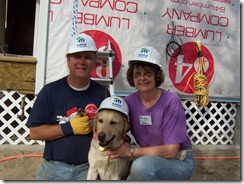
The Habitat crew has learned all about Guide Dog etiquette. They leave Dusty alone when he is in harness, but they pet and play with him when he is out of harness. The college girls want pictures with him. One woman comes for a face-washing from Dusty every day. (Even I won’t let him do that.) Dusty loves the attention from so many people, but he misses his daily long walks with Don. Don is surprising everyone with how well he can work with his limited vision.
We will be heading home to the snow and cold soon, and we will miss working in the sun in short sleeves in January and the wonderful people we have been working with. But it is more than that. Seeing the severe damage to people’s homes chills me. I want to stay; I want to come back and help more because there is so much to do. The devastation is so enormous that our weeks of work seem insignificant. But thousands of people volunteering for a week or a month and thousands of people donating a little of the money they would otherwise splurge for enjoyment can make a big difference. It will take years to rebuild homes for those who have lost theirs, years for the people who have lost everything to become comfortable again. God did not send the hurricanes and destruction, but He wants us to help each other. We are not alone in the world; we must reach out to help others.


