The Rhine and Main Rivers
Our good
friends Alice and Jerry told us last fall that they were planning to take a
river cruise on the Rhine and Danube and asked if we might we be interested. I said instantly, “Yes.
We’re in.”
The Viking Modi (a minor Norse god) was our home for two weeks. We had a French balcony which we found out is four inches wide. It is a patio door with a railing. It actually was nice. We often stood there leaning on the railing watching the river and shore go by.

Amsterdam
After an overnight flight from Chicago, we hit the ground running in Amsterdam at 8:00 AM. We soon slowed to a limping walk though. The wait at Anne Frank’s house was 3 ½ hours. (I had tried and failed to reserve advance online tickets.) So we bought a hop off/hop on ticket for the canal tours and enjoyed the unique architecture of this city ten to twelve feet below sea level. There are no skyscrapers in Amsterdam because the weight would be too much for the pilings driven 45 feet deep that must support buildings when you build below sea level.

After an overnight flight from Chicago, we hit the ground running in Amsterdam at 8:00 AM. We soon slowed to a limping walk though. The wait at Anne Frank’s house was 3 ½ hours. (I had tried and failed to reserve advance online tickets.) So we bought a hop off/hop on ticket for the canal tours and enjoyed the unique architecture of this city ten to twelve feet below sea level. There are no skyscrapers in Amsterdam because the weight would be too much for the pilings driven 45 feet deep that must support buildings when you build below sea level.


Houses along the canals are
18 feet wide, up to 45 feet deep and 3 or 4 stories high. The gable ends are
ornate—very striking. The cargo hook on
top is for hoisting heavy loads or furniture to upper floors.


People live
in about 2500 houseboats moored along the canals.


We did walk a couple streets in the Red Light District. The girls standing in full length windows wearing bikinis were beautiful, but we were warned not to take pictures. So you will have to get the idea from these paintings on the street wall.

Streets are
narrow so more people get around on bikes than cars, 550,000 bikes in
Amsterdam, 50,000 of which get stolen each year. This is a four story bicycle parking garage.

Windmills of
Kinderdyjk

Half of the Netherlands
is below sea level on land reclaimed from the sea by building dykes and pumping
water out. Hollanders perfected the windmills centuries ago to lift water from
canals over a dyke to a higher reservoir where it could removed by opening
sluice gates into a river flowing away.
The resulting polders became farms and villages. The Kinderdyjk polder
is 40 miles by 25 miles, all drained naturally by canals to the lowest area and
then pumped by rows of windmills. The 19
that are left here were built in 1738 and 1740, and are a UNESCO World heritage
site. Present day volunteer millers are
trained for years before being allowed to live in one and manage it.


The windmill
vanes are wooden grids covered by just enough sail to allow them to catch
enough wind to turn at a manageable speed.


The last family that lived in this mill in the early 1900’s raised 12 children in 3 rooms plus the work space in the mill’s 4 floors.

By wooden
gears the rotation transfers down to turn a water wheel under the mill lifting
water from a ditch from the canal to another ditch running to the reservoir.
These old wheels can pump 50,000 liters of water per minute.

The tan fields in the diagram are the potential reservoir.

When the reservoir got high enough, sluice gates opened to allow the water to run into the river. The modern version uses these augers to lift the reservoir's water to the river, so the reservoirs do not fill up as often anymore.


The tan fields in the diagram are the potential reservoir.

When the reservoir got high enough, sluice gates opened to allow the water to run into the river. The modern version uses these augers to lift the reservoir's water to the river, so the reservoirs do not fill up as often anymore.

The Rhine
River
Cologne
Our walking
tour guide in Cologne was a delightful woman with feminist leaning jokes. She pointed out brauhauses, Roman remnants, and the ornate city hall.


Dionysus Mosaic at Roman Germanic Museum


Old city hall

Dionysus Mosaic at Roman Germanic Museum


The jewel of Cologne is the sprawling Gothic cathedral, one of the largest in the world.
The light stone is blackened by pollution over the years, particularly from the
trains at the nearby station. The size and grandiosity are almost overwhelming.


The Middle
Rhine
We toured
the massive Ehrenbreitstein Fortress, taking large cable cars across the Rhine
from the boat to the other side in Koblenz. The military stone fortress was built
to protect the strategic confluence of the Rhine and Moselle Rivers from the
French. It succeeded.


Don, Jean, Alice, and Jerry. Note the Moselle water bluer than the Rhine.


Don, Jean, Alice, and Jerry. Note the Moselle water bluer than the Rhine.

The
Marksburg Castle is a 13th century gem that is rare in that it was
never destroyed.


All
afternoon we sat on the rooftop deck watching the most beautiful stretch of
the Rhine drift by, castle after vineyard after lovely village. We had wine, spiked Rudesheimer coffee and German
desserts.

The vineyards grow in vertical rows for ease in care and picking the grapes, everything done by hand.


The vineyards grow in vertical rows for ease in care and picking the grapes, everything done by hand.

Castles of
the Hostile Brothers who feuded and built separate castles with a wall between.
When they reconciled, they would wake each other with an arrow shot. Tragically
one brother opened his window just as the other sent his arrow there.

Maus Castle


Katz Castle


Rheinstein Castle

We made a quick stop for the staff to take trash off the boat in a kind of bag brigade.


Maus Castle


Katz Castle


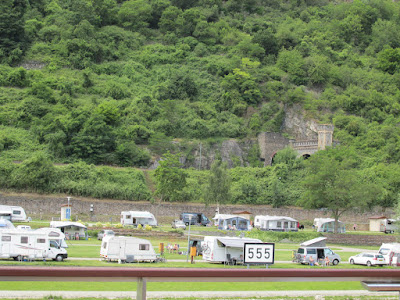
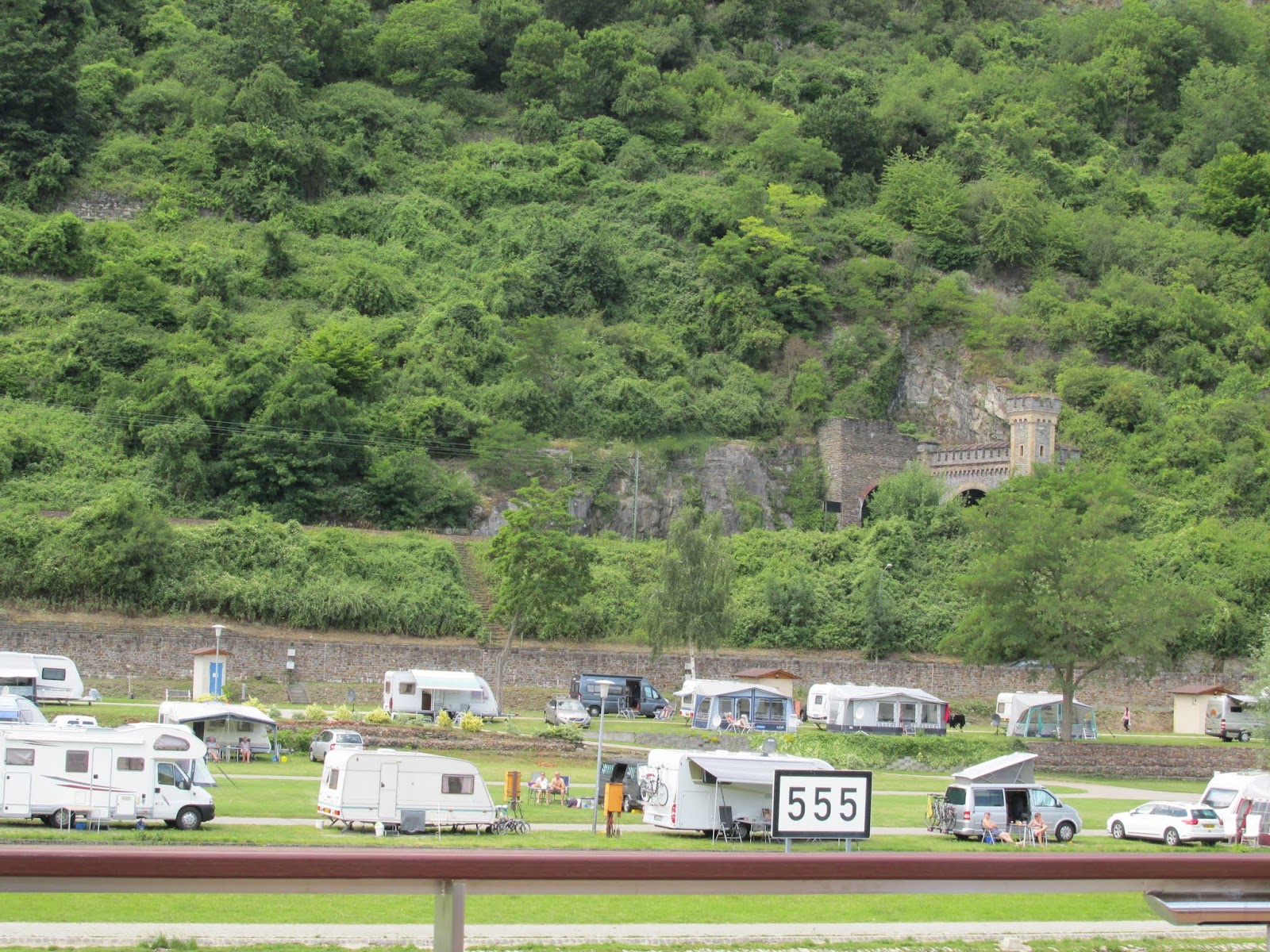
We frequently saw campgrounds along the river.
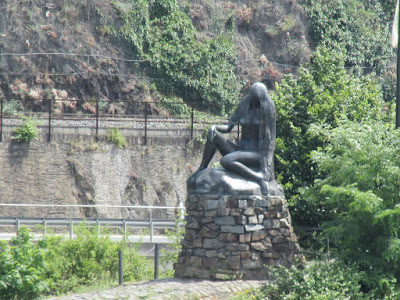
Lorelei was a siren who sat on a high rock above the river and lured sailors to crash. It helped that this was a narrow part of the river with many submerged reefs.
Poet Heinrich Heine helped popularize the legend. Here is a part.
The loveliest maiden is sitting
High-throned in yon blue air,
Her golden jewels are shining,
She combs her golden hair;
She combs with a comb that is golden
And sings a strange refrain
That steeps in a deadly enchantment
The listener's ravished brain.
The doomed in his drifting shallop,
is tranced with a sad sweet tone,
He sees not the yawning breakers,
He sees but the maid alone.
The pitiless billows engulf him,
So perish sailor and bark.

Rheinstein Castle

We made a quick stop for the staff to take trash off the boat in a kind of bag brigade.

The Main River
We left the Rhine at Frankfort to sail the Main since it flows from the mountains closer to the Danube.
Miltenberg
Miltenberg
is a lovely little town. We walked
around the old town and climbed up to the castle atop a hill (seen above the church here) on the edge of the
deep German forest. We often saw swans on the river.


The half-timbered houses and old churches made the walk a joy.


We had a beer in Zum Riesen, the
oldest gasthaus (1590) in Germany where Martin Luther had a beer and Elvis Presley stayed overnight.

Franconia


The half-timbered houses and old churches made the walk a joy.


Franconia
Franconia and
France were all the same people 2000 years ago. Charlemagne, King of the Franks, ruled these lands and became the first Holy Roman Emperor in the 800’s. Later came the
age of smaller principalities and bishoprics like Wurzburg, Bamberg and Nuremberg. The rise of nations saw France taking part of
Rhineland and in return ceding northeastern Franconia to Bavaria. The
Franconians have never been happy with this and do not want to be called Bavarians
even though politically, they are.
The Romantic
Road was not the forests and streams I expected. It is farmland and charming villages where
the people live rather than on the farms themselves. Cattle stay indoors while the fertile land
produces crops to feed the animals as well as sugar beets, wheat, and other
crops. Franconian white wine is a
wonderful wine in distinct bocksbeutels, a word which could mean brook bag or corrupted
by time to goat scrotum. Oh, well, the flat bulbous glass bottles hold a lovely
wine.


Rothenburg
Rothenburg
is one of the best preserved walled medieval town existing.


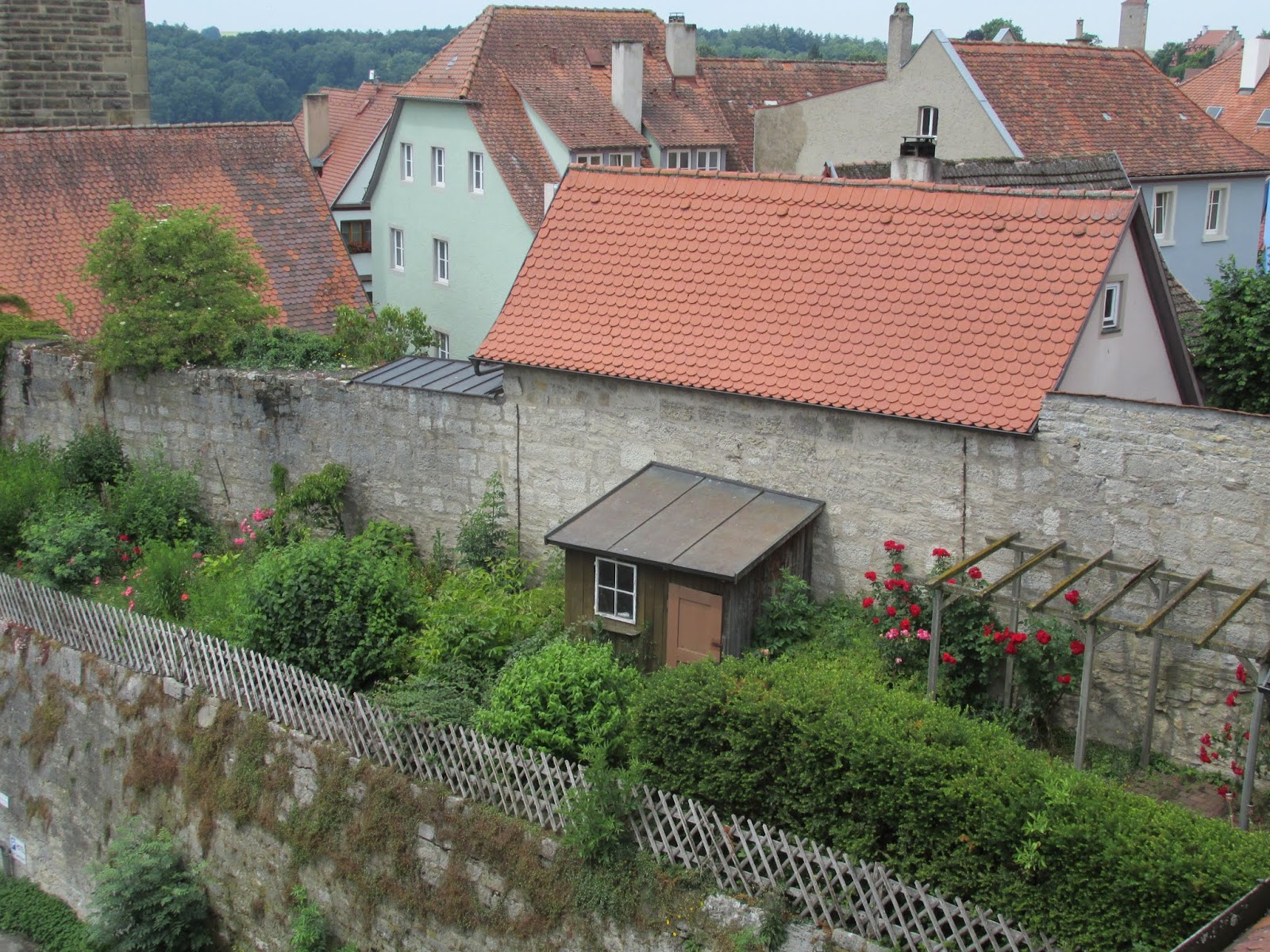
We walked the city wall which still surrounds the entire old town. Lovely to look down into people’s gardens.


We walked the city wall which still surrounds the entire old town. Lovely to look down into people’s gardens.



Wurzburg
The cathedral in Wurzburg is enormous with several wings and a chapel devoted to St. Killian who brought Christianity to Franconia.

Archbishop Johann Von Schoenborn also became prince of Wurzburg and decided he needed a Residenz to reflect his position. He hired the renowned architect Balthasar Neumann to design a sumptuous Baroque palace with gold leaf everywhere and the largest ceiling fresco in the world.


The cathedral in Wurzburg is enormous with several wings and a chapel devoted to St. Killian who brought Christianity to Franconia.

Archbishop Johann Von Schoenborn also became prince of Wurzburg and decided he needed a Residenz to reflect his position. He hired the renowned architect Balthasar Neumann to design a sumptuous Baroque palace with gold leaf everywhere and the largest ceiling fresco in the world.

Marienburg
Fortress above Wurzburg


Franconia countryside
Zeil is a
Franconian village that was known for its witch hunts in the 1700’s. People
were accused for a variety of reasons. The Prince Bishop of Bamberg, a
superstitious man, encouraged this mindset and used witch accusations to get
rid of political enemies. Those accused
were tortured until they confessed and then burned.


Zeil’s
half-timbered houses showed the owners wealth by the complexity of the timber
designs used in the construction.


Maria
Limbach Walfurtkirche (lim for the linden tree, bach for brook, walfurt for
pilgrimage). This modest sized, but highly ornate, church set among fields and hills was a popular pilgrimage destination.


The Three
Crowns (for the wise men) serves its own beer, one of them smoked beer. The green brewer’s malt is dried over a beech
wood fire giving a lovely smoked flavor to the beer. You either love it or hate it. I loved it; Don hated it.


The region
of eastern Franconia and northern Bavaria has the densest collection of
breweries in the world: 250 in a 60 mile
radius of Nuremberg. Each brewpub serves only their own; many don't bottle it.
In Bamburg
we toured their prince bishop’s summer palace/hunting lodge. Not quite up to Wurzburg’s, but impressive
all the same.


Nuremberg
Nuremberg brought
a sobering look at WW II history. We visited
the Nazi Party Rally Grounds, a grandiose amphitheater that was intended for Hitler
to address the masses. It was never
finished, but other structures were used by the Nazis as they considered
Nuremberg an important area. The
amphitheater stands but is not maintained—deliberately so as not to honor
it. Built into one corner is an impressive
museum that explains the Nazi machine and Hitler’s rise to power. Intense.


We then
visited Courtroom 600 where the Nuremberg trials were held to convict most of
the top level Nazis. A few committed suicide besides Hitler. Three were
acquitted due to evidence that they were not as culpable, and proving to the
world that the trials were conducted fairly, not just in vengeance as were Stalin’s
war trials which lasted a couple hours. The Nuremberg process led to the
permanent establishment of International law and the world court at The Hague.


We wandered
the old town a bit and shared a Nuremberg bratwurst lunch with others form the
ship. Their sausages are very good,
small like a breakfast link. Wonderful
sauerkraut and German potato salad too.


We four are
retired teachers, and we were surprised to meet so many other teachers on the trip. Dinner conversations with them was always
interesting. Many of them also did the
optional Nazi tour—I guess teachers never stop wanting to learn.
Main-Danube Canal
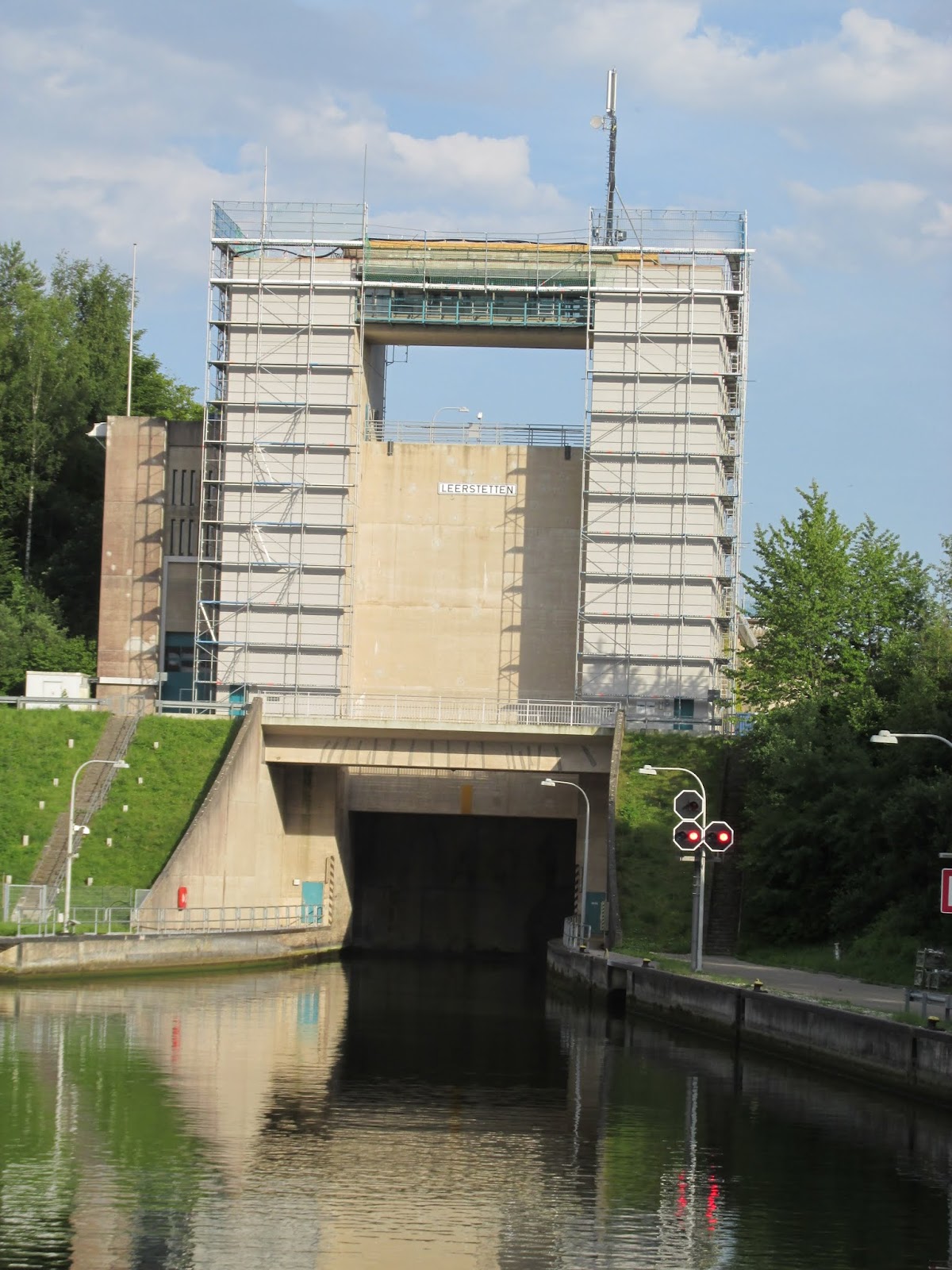
The cruise in its entirety uses 64 locks to go upriver on the Rhine and Main rivers, transverse the Main-Danube Canal, and descend the Danube to Budapest. Most are typical river locks, but in the Main-Danube Canal they become very high. The canal, 106 miles long, is a marvel of engineering in that it goes across a continental divide. Its 16 locks raise the canal to an elevation of 1332 feet above sea level. The three highest locks are about 80 feet high. The water for the highest lock is pumped up from the Danube and Main Rivers and stored in reservoirs and reused over and over. Some water, of course, runs down with the ships, but 60% goes back into the reservoir to be reused. Amazing!

One day we returned to the ship to find the staff waiting for us--so sweet. With only 189 guests and 3 floors, we felt like a big family by the end of the trip.